Levirate Marriage and the Family in Ancient Judaism Dvora Weisberg
Levirate spousal relationship is a type of marriage in which a adult female marries one of her married man'due south brothers afterward her husband's death. The term is a derivative of the Latin word levir, meaning "husband'south brother."
Levirate union has been practiced by societies with a strong clan structure in which exogamous marriage—martial unions outside of the clan—was forbidden. It is all-time known from stories in the Hebrew Bible, where it was practiced among the early on Israelites. In Jewish tradition, the virtually famous levirate marriages took place in the family unit of Judah, whose daughter-in-police force Tamar ultimately married Judah himself afterwards 2 previous marriages resulted in the deaths of her husbands. The story of Ruth and Boaz describes a derivative form of levirate marriage, involving relatives more distant than brothers. Later on and current Jewish tradition allows for the parties to opt out of levirate marriage through a process known every bit halizah.
Contents
- 1 In the Bible and Judaism
- 1.1 In the New Testament
- 1.2 Laws of yibbum and halizah
- 2 Other cultures
- 2.1 Central Asia
- ii.2 Africa
- 2.3 Elsewhere
- 3 See too
- four Notes
- five References
- 6 Credits
Levirate marriage is or was also known in many other societies, including the Punjabis, Jats, Huns, Apache, Mongols, and Tibetans. Some, but by no ways all, cultures that practice levirate marriage also practice the related custom of soroate spousal relationship, in which a deceased wife's sister marries the dead woman's hubby.
In the Bible and Judaism
In Judaism, levirate marriage, known equally yibbum (pronounced "yee-smash"), is a marital matrimony mandated by the Torah in Deuteronomy 25:five-10, obliging a blood brother to marry the widow of his childless deceased brother.
When brothers live together, and 1 of them dies childless, the dead human's wife shall not be allowed to marry an outsider. Her husband'southward brother must cohabit with her, making her his married woman, and thus performing a blood brother-in-police force's duty to her. The first-born son whom she bears volition then perpetuate the name of the dead brother, and so that his name volition not be obliterated from State of israel (Deuteronomy 25:5-half dozen).
Marriage with a brother'due south widow was normally forbidden among the Jews (Leviticus 18:16; 10:21), except for the case of yibbum. The advantage to the brother who agreed to marry his sister-in-police was that he would exist the sole distributor of his brother'southward estate instead of splitting it with the family. The disadvantage would be that if the levirate union resulted in male person outcome, the child would be named later on the deceased brother and considered to exist his offspring.
Examples of levirate union include the marriages of Tamar and Onan the son of Judah (Genesis 38:6-10). In this case, Onan was besides cursed to death for attempting to avoid conception after the marriage was consummated. Another levirate‑type spousal relationship in the Hebrew Bible was the later union of Tamar with her begetter-in-law Judah afterward Judah had refused to allow her to marry his youngest son after Onan's death (Gen. 38:8).
The story of Judah and Tamar served to emphasize the importance of levirate marriage in the days when the Israelites were even so a family kinship group. However, in later times a provision was made so that parties might legally opt out of yibbum. In such cases, a anniversary known as halizah would be performed, involving a symbolic act of renunciation of their right to perform this wedlock. Jewish law (halakha) has seen a gradual refuse of yibbum in favor of halizah, to the point where in nigh contemporary Jewish communities yibbum is strongly discouraged.

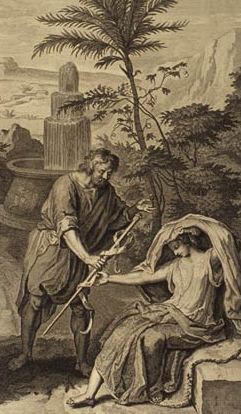
Boaz discovers Ruth lying at his feet.
A famous case involving a instance coordinating to both halizah and yibbum is recounted in the Book of Ruth. Here, afterwards the decease of her married man, Ruth is rejected by an anonymous closer relative, only is accepted by her married man's remaining kinsman, Boaz. In Ruth four, Boaz carefully insures that the closer relative formally waives his right to act as Ruth's redeemer earlier himself claiming the right. This story from the Volume of Ruth describes a custom involving a wider kinship necktie than normal levirate marriage, since neither Boaz nor the closer relative were technically subject to the laws of yibbum or halizah under either Talmudic law or Deuteronomy.
In the New Attestation
The New Testament preserves a tradition indicating that the custom of levirate wedlock posed thorny questions for the Jews of the first century. According to the Gospel of Luke, certain Sadducees posed a challenge to the doctrine of the resurrection, which both Jesus and the Pharisees taught, by saying:
"Moses wrote for united states that if a man's brother dies and leaves a married woman merely no children, the human must ally the widow and have children for his brother. Now in that location were seven brothers. The kickoff one married a woman and died childless. The 2nd and and then the third married her, and in the same way the vii died, leaving no children. Finally, the woman died too. Now so, at the resurrection whose wife will she be, since the seven were married to her?" (Luke twenty:28-31)
Jesus, in effect, dodged the question past declaring that, during the resurrection, there would be no marriage. Rabbis of a later era tended to solve the problem past downplaying the obligation of levirate marriage.
Laws of yibbum and halizah
Halakha (Jewish police force) has a rich tradition effectually yibbum. These laws were first recorded in the Mishnah (late second century) and the Talmud, and were later codification by Maimonides in the Mishneh Torah. The subject is considered 1 of the most intricate in Jewish police, partly because of the complications that arise from multiple brothers and multiple wives.
Co-ordinate to these traditions, when a married man dies without having any children, male or female person, from any relationship—including premarital and extra marital—his widow and his brother must perform either yibbum (levirate marriage) or halizah (formally waiving the levirate custom). It the case of yibbum, in that location is no technical demand for a marriage anniversary betwixt the widow and the deceased'due south blood brother, as they are already spring by divine decree.[1] Nevertheless the rabbis established that the couple should perform a marriage-like ceremony known as maamar, [2] recite the wedlock blessings, and write a prenuptial agreement.[3] It is forbidden for the widow to remarry another until halizah has been performed. While whatever blood brother tin perform yibbum or halizah, the greater obligation is on the oldest blood brother offset.
The Samaritans reportedly followed a different course, practicing levirate spousal relationship only when the woman was matrimonial, rather than married, and the relationship had not been consummated.[4] The Karaites announced to have followed the aforementioned practice, and the Karaite scholars Benjamin Nahawendi and Elijah Bashyazi both expressly favored it.[5]
A difference of opinion appears among the later Jewish authorities regarding the need for yibbum. Alfasi, Maimonides, and the Spanish school more often than not upheld the custom of levirate, while Rabbeinu Tam and the Northern schoolhouse preferred halizah.[6] Interestingly, one ruling held that a alter of religion on the function of the surviving brother does not affect the obligation to perform yibbum or halizah.[seven]
Orthodox Jews in modern times have mostly uphold the position of Rabbeinu Tam and perform halizah rather than yibbum. Conservative Judaism also officially retains the traditions of yibbum and halizah. Reform Judaism and Reconstructionist Judaism have abolished both yibbum and halizah.
Other cultures
Central Asia
Levirate marriages were widespread among Cardinal Asian nomads. Chinese historian Sima Qian(145-87 B.C.East.) described the practices of the Huns in his magnum opus, Records of the Grand Historian. He attested that subsequently a man's death, ane of his relatives, normally a brother, marries his widow.
The levirate custom survived in the lodge of Northeastern Caucasus Huns until the seventh century C.E. Armenian historian Movses Kalankatuatsi states that the Savirs, one of Hunnish tribes in the expanse, were usually monogamous, but sometimes a married man would have his brother's widow every bit a polygynous wife. Every bit women had a loftier social status, the widow had a choice whether to remarry or non. Her new husband might exist a brother or a son (by another woman) of her start hubby, so she could end upward marrying her brother-in-police or stepson; the departure in age did not matter.[8]
Ludmila Gmyrya, a Dagestani historian, asserts that the levirate spousal relationship survived there into "ethnographic modernity" probably meaning the 1950s.
Soviet historian А. Yard. Khazanov gives economical reasons for the longevity of the levirate over ii millennia of nomadic history: inheritance of a wife as a part of the deceased's property and the necessity to support and educate children to continue the line of the deceased. The levirate custom was revived nether shaky economic conditions in the deceased's family. Khazanov, mentions that during Globe War II the levirate custom was resurrected in Central Asia. In these circumstances, developed sons and brothers of the deceased man held themselves responsible to provide for his dependents. One of them would thus marry the widow and adopt her children, if there were whatever.[9]
Africa
Levirate wedlock has also been practiced by central and southern African peoples. Amid the Igbo of southeastern Nigeria it was a mutual practice for a woman to marry her widowed husband'southward blood brother if she had children, and then the children could retain the family identity and inheritance and not take to deal with step families. To a certain degree, still in practice. In countries such as Southward Africa, the obligation for a adult female to enter into a levirate marriage is on the decline due to increasing sensation of women'southward rights. Among the Akan people of Ghana and Republic of cote d'ivoire, a custom of cross-cousin marriage serves the same function as leverite union. In the Sudan, the Nuer people practice a tradition like to that of the aboriginal Hebrews, in which the children of a remarried levirate widow belong to her starting time husband's lineage.
Elsewhere
In South America, Yanomamo tribe of the Amazon rainforest in Brazil and Venezuela likewise practices cantankerous-cousin wedlock, in which kinship groups that have formed alliances through wedlock attempt to maintain these bonds by having the deceased's widow marry his close relative.
The levirate custom was too fairly common in Southeast Bharat, where polygyny—where several several wives share one husband—was fairly common and the levirate practise provided a method to ensure that each woman and her children would accept a male provider in case of their common husband'due south death. Levirate marriage was also adept by the Australian Aborigines. Among the Apache Indians of North America, both levirate and soroate marriages were reportedly mutual.
Encounter likewise
- Tamar
- Book of Ruth
- Widow
Notes
- ↑ Mishneh Torah, Laws of Yibbum and Halizah 1:1.
- ↑ Mishneh Torah, Laws of Yibbum and Halizah two:one.
- ↑ Shulchan Aruch, Eben ha-'Ezer, 166:2; Mishneh Torah, Laws of Yibbum and Halizah 2:2.
- ↑ Talmud Kiddushin 65b.
- ↑ Adderet Eliyahu, "Nashim," p. 93a.
- ↑ Shulchan Aruch, Eben ha-'Ezer, 165.
- ↑ Isaac ben Sheshet, Responsa, i. 2.
- ↑ L. Gmyrya, Hun State At The Caspian Gate (Dagestan: Makhachkala, 1995), 212.
- ↑ A.M. Khazanov, Social History of Scythians (Moscow, 1975), 82.
References
ISBN links support NWE through referral fees
- Kirwen, Michael C. African Widows: An Empirical Study of the Problems of Adapting Western Christian Teachings on Marriage to the Leviratic Custom for the Care of Widows in Four Rural African Societies. Maryknoll, NY: Orbis Books, 1979. ISBN 9780883440094.
- Leggett, Donald A. The Levirate and Goel Institutions in the Old Testament: With Special Attending to the Book of Ruth. Cherry Colina, N.J.: Mack Pub. Co, 1974. OCLC 2183391.
- Sapir, Edward. Terms of Relationship and the Levirate. Berkeley, CA: California Indian Library Collections [distributor], 1992. OCLC 58866705.
- Weisberg, Dvora E. The Widow of Our Discontent: Levirate Spousal relationship in the Bible and Ancient Israel. London: Continum Pub. Group, 2004. OCLC 79456817.
Credits
New World Encyclopedia writers and editors rewrote and completed the Wikipedia article in accordance with New World Encyclopedia standards. This article abides by terms of the Creative Commons CC-by-sa three.0 License (CC-past-sa), which may exist used and disseminated with proper attribution. Credit is due under the terms of this license that can reference both the New Earth Encyclopedia contributors and the selfless volunteer contributors of the Wikimedia Foundation. To cite this article click here for a listing of acceptable citing formats.The history of before contributions by wikipedians is accessible to researchers hither:
- Levirate Union history
The history of this commodity since it was imported to New World Encyclopedia:
- History of "Levirate Marriage"
Notation: Some restrictions may apply to apply of individual images which are separately licensed.
Source: https://www.newworldencyclopedia.org/entry/Levirate_Marriage
0 Response to "Levirate Marriage and the Family in Ancient Judaism Dvora Weisberg"
Post a Comment