11 Broadway Suite 1515 New York Ny 10004 Art
| Bowling Light-green Offices Building | |
|---|---|
 The building's exterior in 2020 | |
 | |
| General data | |
| Blazon | Role |
| Architectural style | Hellenic Renaissance |
| Location | xi Broadway Manhattan, New York 10004 |
| Coordinates | 40°42′nineteen″N 74°00′51″W / 40.70528°N 74.01417°Westward / xl.70528; -74.01417 Coordinates: 40°42′19″N 74°00′51″West / xl.70528°Northward 74.01417°W / 40.70528; -74.01417 |
| Construction started | 1895 |
| Completed | 1898 |
| Pinnacle | |
| Roof | 272.5 ft (83 yard) |
| Technical details | |
| Flooring count | 21 (+2 basement) |
| Design and construction | |
| Builder | W. & G. Audsley |
| New York Metropolis Landmark | |
| Designated | May 16, 1995 |
| Reference no. | 1927[1] |
| U.South. Historic district | |
| Designated | February 20, 2007[2] |
| Part of | Wall Street Historic District |
| Reference no. | 07000063[2] |
| References | |
| Bowling Green Building at Emporis | |
The Bowling Green Offices Building (also known equally the Bowling Green Building, Bowling Green Offices, or 11 Broadway) is an part edifice located at eleven Broadway, across from Bowling Dark-green park in the Financial District of Manhattan in New York City. The 21-story building, erected betwixt 1895 and 1898, is 272.5 feet (83.1 m) tall.[3]
The Bowling Green Offices Building was congenital to a Hellenic Renaissance-style design past W. & G. Audsley. The building's joint consists of iii horizontal sections similar to the components of a column—namely a base, shaft, and capital letter—and has a facade of granite at its base and white brick on the upper stories. The edifice contains an interior skeleton of structural steel, several ornamental features on the facade, likewise as a floor program that maximizes natural low-cal exposure.
The Bowling Dark-green Offices Building, erected as a 16-story structure, initially hosted diverse steamship offices due to Bowling Greenish's proximity to the New York Harbor, and later hosted law firms and other companies. The Broadway Realty Company, for whom the building was congenital, owned 11 Broadway for several decades following its completion. V boosted stories were built in 1920–1921. In 1995, the New York Metropolis Landmarks Preservation Commission (LPC) designated xi Broadway as an official metropolis landmark. It is also a contributing property to the Wall Street Historic District, a National Register of Historic Places district created in 2007.
Description [edit]
The Bowling Dark-green Offices Building was designed by Westward. & G. Audsley.[4] [five] Information technology is bounded past the International Mercantile Marine Visitor Building (1 Broadway) to the southward, Broadway to the e, Greenwich Street to the west, and the Cunard Building (25 Broadway) to the north. Its alternate addresses are 5-11 Broadway and v-eleven Greenwich Street.[half dozen] The building has a frontage of 161.33 feet (49 one thousand) on Broadway and 151.83 feet (46 m) on Greenwich Street;[seven] [8] [ix] the southern purlieus of its lot is 170.5 feet (52 grand) long and the northern boundary 200.33 feet (61 thou) long.[8] [9]
Course [edit]
The original construction was 16 stories[10] [a] and was expanded to 21 stories in 1917. These consisted of a full seventeenth story that covered most the entire lot, equally well as an additional iv stories that comprised a smaller tower above the center north department of the lot.[12] This tower has a facade of buff-colored brick and terracotta, with a mansard roof made of copper.[thirteen] There was a penthouse apartment for its resident superintendent.[14]
The building is "U"-shaped, with the two wings on Broadway and Greenwich Streets surrounding a due south-facing light court. The courtroom abuts a n-facing court within the International Mercantile Marine Company Building,[b] which is also "U"-shaped.[12] [nine] The lite courtroom measures 110 anxiety (34 m) from north to south and 60 feet (18 grand) from westward to east, and is present in a higher place the first flooring.[9]
Facade [edit]
The western and eastern facades of the Bowling Green Offices Building are bundled in iii sections, consisting of a three-story "base", a "shaft", and a iii-story "uppercase" on top, similar to the components of a column. This was a mutual setup for facades of buildings that were being erected in the late 19th and early 20th centuries.[10] The Bowling Green Offices Edifice's facade is made of white granite—an influence from Neoclassical compages—as well as white brick and terra cotta.[10] [xvi] The facade consists of thirteen vertical bays on Broadway and xiv on Greenwich Street. The bays are separated by slightly projecting piers, and each floor is separated by slightly recessed horizontal spandrels, creating a grid of windows.[10] The southern facade of the Bowling Light-green Offices Building is visible above the International Mercantile Marine Visitor to the s.[12]
Dissimilar other buildings of that era, which used arcades as a method of joint for the base, the Bowling Light-green Offices Edifice uses anthemia and other Hellenic-style ornamentation, similar to Milwaukee's Layton Art Gallery building and St. Louis's Wainwright Building. The Bowling Light-green Offices Building greatly resembles the Wainwright Building, except for the colors of the facades.[10] The building is estimated to have over a hundred anthemia on its facade. The Real Estate Tape and Guide said in 1897 that the Bowling Green Offices Building had "more anthemia than any other work with which we are acquainted".[17] [xviii] Despite this, the Bowling Green Offices Building's facade has a very trivial other ornamentation, and the Hellenic decoration is confined to the lower three stories.[x] Audsley wrote that he believed "sculpture should be within easy range of the middle [...] and used sparely in the high portions".[9]
Broadway [edit]

Broadway facade; the projecting outer bays can exist seen at left and right
The east-facing Broadway facade is xiii bays broad and 17 stories high and is the edifice'southward principal elevation. From the bottom to the meridian, this elevation consists of a two-story base, a twelve-story shaft, a two-story capital, and a height story that was added during 1920–1921.[12]
The base is made of a white-granite pillar above a gray-granite water table. The pilasters of the pillar are carved with decorations such as anthemia and support a detailed entablature with the carved words bowling green offices; behind the pillar tin can be seen small segments of rusticated wall. The center bay contains a stoop made of gray granite. The outermost three architectural trophy comprise slightly projecting pavilions, and there are detailed archway surrounds around the first-floor openings of the pavilions.[12] The base as well contains statuary door and window openings on the first story and aluminum-framed sash windows on the second stories. There are cornices higher up the second and 3rd stories.[13]
The third story serves as a "transition" story; the centre vii trophy feature half-columns and the outer 6 trophy characteristic rectangular piers. The following xi stories contain unadorned vertical piers and horizontal molded spandrels above each story. The window openings are framed by short sections of rusticated wall. The tops of the 13th and 14th stories likewise contain cornices.[thirteen]
The 15th and 16th stories contain vertical piers that correspond to the design of the base, likewise equally aluminum-framed sash windows. The top of the 16th story contains a large cornice with a carved frieze. The 17th story has a facade of buff brick, window openings with double-hung windows, and a cornice of brick and white terracotta.[13]
Other facades [edit]
The west-facing Greenwich Street facade, like to the Broadway facade, is divided into an elaborate base of operations, a simple shaft, and a more detailed capital topped by the brick-faced 17th story. It contains less elaborate features than the Broadway facade: for instance, there are no projecting pavilions flanking this side. The Greenwich Street facade is xviii stories high, with a full basement faced with brick and granite, since it is at a lower terrain elevation than Broadway. At that place is a double-width entrance portico on the northern part of the facade, too as a freight entrance nearby; both incorporate carved overhead plaques in a higher place. Different on the Broadway side, the vertical piers are faced with brick. The 15th and 16th stories contain an oriel window, and the 17th story is a mansard roof fabricated of copper.[13]
The south facade is broken upwards into western and eastern wings. Both sections are mostly blocked past 1 Broadway, and only the 13th through 17th stories are visible. The 13th through 16th stories consist of a white wall while the 17th story is a buff brick wall.[13]
The north facade is more often than not blocked by the Cunard Edifice; the visible section consists of a brick wall with windows. It is topped past a four-story tower, which is visible from the edifice'southward other iii sides.[13]
Features [edit]
The Bowling Green Offices Building contains a steel skeleton,[10] [nineteen] with steel columns placed inside alternate vertical piers.[10] The structure used over five,000 short tons (4,500 long tons; 4,500 t) of steel.[19] The building'due south firefighting system used standpipes and compressed-air drums, rather than the water towers used on many contemporary buildings. The standpipes could maintain a pressure of 200 pounds per foursquare inch (1,400 kPa), which would allow 160 U.S. gallons (610 L) of water per minute to exist projected 66 feet (20 m) in a 0.75-inch (xix mm) stream. The firefighting organization, which could also feed water to burn engines if necessary, was praised by the New York City Fire Commissioner.[20]
The entrance foyer and primary corridor contain a marble floor, while a stained-drinking glass mural dating from the building'south structure is mounted on the walls of the corridor.[20] When built, the Bowling Light-green Offices Building included 16 elevators.[21] Of these, eight were clustered in the vestibule in the northern portion of the building. Another elevator on the Greenwich Street side could be used past freight or passengers and could support loads of up to 7,000 pounds (three,200 kg).[22]
History [edit]
The site of the Bowling Green Offices Building was occupied by Dutch houses after the colony of New Amsterdam was founded in the 17th century.[23] The Atlantic Garden House (Burns' Coffee House) had previously occupied the site of 11 Broadway by the 19th century,[four] [24] [25] and had occupied the site since at to the lowest degree the 18th century.[26] Later, one of the New York and Harlem Railroad's freight depots was located at the site.[4]
Construction [edit]
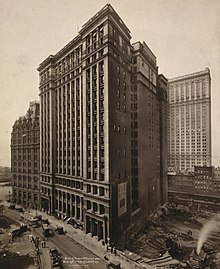
Seen in 1919, prior to addition of the top five floors
The Bowling Green Offices Building'south site was owned by lawyer Joseph F. Stier, who sold the country in June 1895[4] [27] [11] to Stacy C. Richmond.[4] [28] The adjacent month, the then-new Broadway Realty Company submitted plans for the site to the New York Urban center Department of Buildings. The company was led by five men and had a board of directors that included Stier and Richmond, too every bit philanthropist Spencer Trask,[four] who, existence the largest stakeholder in the building, would maintain a suite on the tiptop floor for several years.[29] [5]
The precise details of how Audsley became involved in the projection is not clear, though he may have been hired through clan with George Foster Peabody, who was Trask's principal partner.[9] Records from McKim, Mead & White allude to the possibility that an architectural competition may have been organized.[xi] Construction of the original structure, which was 16 stories and cost $one.viii one thousand thousand, started in Oct 1895.[ten] The building was completed in two sections: the Broadway side was fix for apply in mid-1896,[30] while the rest of the building was completed in Nov 1898.[10] Co-ordinate to ane source, the Bowling Dark-green Offices Building was congenital "by British interests" with funding from Queen Victoria.[31] Original plans chosen for a belfry to exist built atop the rest of the building, only the tower plans were not carried out.[11]
Apply [edit]
Early tenants [edit]
At the time of its opening, the Bowling Green Offices Edifice was the largest edifice on Bowling Green.[12] [c] A promotional brochure for the Bowling Green Offices Building advertised its fireproof textile; electricity;[d] proximity to the Ninth Avenue elevated and the then-under-construction subway; and elevators to the restaurant and apartments on the upper floors.[34] [xxx] Electricity, heating, and janitor service were given to potential tenants for gratuitous.[30] A 1900 consequence of the Real Estate Record and Guide quoted the elevators as carrying 18,000 people per day, while the edifice had an boilerplate of 6,000 people during meridian piece of work hours.[35] Profits from the Bowling Green Offices Edifice went toward funding Yaddo, the artists' customs in Saratoga Springs, New York, that had been founded by Trask.[36]
The Broadway Realty Company filed a lawsuit after the New York City Department of Taxes raised the building'southward valuation from $1.v 1000000 in 1898 to $ii million in 1899. The Department of Taxes ruled that the assessment was justified, but the Appellate Division of the New York Supreme Court overruled the conclusion.[37] In 1903, the New-York Tribune reported that, when Trask'south automobile driver was arrested, Trask had offered the $ane meg Bowling Green Offices Building to cover his commuter's $500 bond amount.[38] During the 1910s, there were ii incidents involving elevators at 11 Broadway. In 1915, seven elevators dropped downward their shafts with a combined 30 people in the cabs, though no one was hurt because of safety systems that slowed down the elevators at the lesser.[39] The next year, a human being was hurt when iv lift cabs dropped.[forty]
Expansion and later use [edit]
Ludlow and Peabody made numerous major modifications in the early on 20th century. The firm redesigned the staircases on the Broadway side in 1912–1913 by moving the front steps inward and removing or reconfiguring part of the facade. A few years later, the Broadway Realty Visitor planned to add together v more stories at the tiptop of the building to designs by Ludlow and Peabody, simply due to steel shortages caused by World War I, the work was not completed until 1919–1920.[12] [xvi] [11] Building plans in 1938 indicate there was a restaurant, likely facing Greenwich Street, and a photo from the same twelvemonth indicated that storefronts had been added on Broadway to either side of the center stoop.[12]
The building was sold to Chester W. Hansen'southward real-estate syndicate in 1926 equally part of a $9 meg transaction. This was the first buying change since the building's opening.[7] [41] However, the LPC stated that Broadway Realty continued to own the building until 1978, or at least the land beneath it,[4] citing the company'south Restatement of Certificate of Incorporation filed that year.[42] According to a former director of Yaddo, the community held the controlling interest in the Bowling Green Offices Building until 1976, equally opposed to outright ownership.[43] By the 1930s, fewer tenants were occupying the Bowling Light-green Offices Building considering of the structure of new role buildings in Midtown Manhattan.[36]
In 1995, the Bowling Greenish Offices Edifice and several other buildings on Bowling Light-green[e] were formally designated as New York City landmarks.[44] [1] In 2007, the building was designated every bit a contributing property to the Wall Street Celebrated District,[45] a National Annals of Historic Places commune.[ii] As of 2020[update], 11 Broadway is endemic by Braun Direction.[46]
Tenants [edit]

Subway restaurant and bus cease outside the Bowling Green Offices
The Bowling Light-green Offices Building's previous tenants have included bankers, lawyers, utility companies, engineers, naval architects, and ship companies.[12] [47] As originally built, information technology included 512 offices.[48] [35] These were used past several companies involved in the steamship and shipping industries, such as steamship lines, shipbuilders, ship suppliers, and freight forwarders.[12] [48] [49] [50] The steamship companies included the White Star Line, which endemic the RMSTitanic;[7] the American Line; and the American Scantic Line.[12] Additionally, the Shipping and Industrial Sound Money Association of the Port of New York opened offices in the building in 1900,[51] and the Erie Railroad also had offices in the building in the early on 20th century.[52] Other tenants included the U.s.a. Department of the Navy'due south Supervisor of Shipbuilding, also as the Merchant Marine Committee of the Whole.[12]
By 1926, tenants included Tidewater Oil, industrial company Ingersoll-Rand, bankers Henry Clews & Company, lawyer Max Steuer, and steamship line Moore-McCormack.[seven] Later on in the 20th century, space in the Bowling Green Offices Building was taken upwardly past Ivan Boesky, a stock trader implicated in insider trading,[47] too as the technology company IBM.[53]
In the 21st century, tenants include or accept included Colina West Architects,[46] [54] [55] SogoTrade,[46] [56] the Flatiron Schoolhouse,[46] [57] Allmenus, and Universal Studios.[46] The New York State Department of Motor Vehicles has an office on the 11 Greenwich Street side of the building.[58]
Critical reception [edit]
The Bowling Light-green Offices Building received relatively lilliputian media coverage upon its completion. Although architectural writers Sarah Landau and Carl Condit wrote in 1996 that the Bowling Green Offices was "a major piece of work of the [1890s] in both design and size", information technology was ignored "perhaps because it was completed in a boom building period or because its 'Hellenic Renaissance' style was considered so peculiar".[5]
A writer for the Existent Manor Record and Guide lambasted the design, proverb that it "is quite too conspicuous to be ignored". The reviewer continued: "If the architects had been less solicitous for novelty and had abstained from trying to produce 'an order practically unique', their building would have been much better".[xviii] Some other critic said that the design had been intended to "boldly admit and fifty-fifty [...] accentuate elevation".[9] A 1998 letter of the alphabet to the editor, published in The New York Times, said that 11 Broadway's design was "for those who wish to enjoy the architecture of" Scottish architect Alexander Thomson. The alphabetic character described 11 Broadway's base as "a literal copy" of Thomson's designs.[59]
See too [edit]
- List of buildings and structures on Broadway in Manhattan
- List of New York City Designated Landmarks in Manhattan beneath 14th Street
References [edit]
Notes [edit]
- ^ The building rose 17 stories to a higher place Greenwich Street and 16+ 3⁄4 stories on Broadway.[eleven]
- ^ In its study about the Bowling Green Offices Edifice, the New York City Landmarks Preservation Commission refers to this structure as the "Washington Building".[12] The Washington Building was remodeled into the International Mercantile Marine Visitor Building in 1919–1921 according to another LPC report.[15]
- ^ The New York Produce Substitution had a larger lot expanse but only consisted of 3 stories, and the narrow Hudson Edifice (32-34 Broadway) had 17 stories merely was very narrow.[12] [16]
- ^ An advertisement for the New York Edison Visitor claimed that electric service did not get-go until 1907.[32] The LPC did not detect a satisfactory explanation for these conflicting dates.[33]
- ^ Namely the outside and beginning flooring interior of the Cunard Building; 26 Broadway; and the International Mercantile Marine Company Building[44]
Citations [edit]
- ^ a b Landmarks Preservation Commission 1995, p. i.
- ^ a b c "National Annals of Historic Places 2007 Weekly Lists" (PDF). National Park Service. 2007. p. 65. Archived (PDF) from the original on December 28, 2019. Retrieved July 20, 2020.
- ^ "Bowling Green Building". Emporis. Archived from the original on Feb iv, 2020. Retrieved Feb 4, 2020.
- ^ a b c d e f k Landmarks Preservation Commission 1995, p. 2.
- ^ a b c Landau & Condit 1996, p. 242.
- ^ Landmarks Preservation Commission 1995, p. 1.
- ^ a b c d "Bowling Green Skyscraper in Reported Deal: Syndicate Said to Have Obtained Option of Purchase on the Twenty-2-Story Building at 11 Broadway". New York Herald Tribune. Dec 16, 1926. p. 40. Archived from the original on Feb 6, 2020. Retrieved February two, 2020 – via ProQuest.
- ^ a b Courtroom of Appeals 1919, pp. 89–xc
- ^ a b c d east f g Landau & Condit 1996, p. 244.
- ^ a b c d e f g h i j Landmarks Preservation Commission 1995, p. 3.
- ^ a b c d due east Landau & Condit 1996, p. 426.
- ^ a b c d e f g h i j k 50 m north Landmarks Preservation Committee 1995, p. four.
- ^ a b c d e f g Landmarks Preservation Commission 1995, p. 5.
- ^ Greyness, Christopher (September seven, 2003). "Streetscapes/Readers' Questions; Firm and Garden, and Offices With a Penthouse". The New York Times. ISSN 0362-4331. Archived from the original on February half-dozen, 2020. Retrieved February 6, 2020.
- ^ "International Mercantile Marine Company Building" (PDF). New York City Landmarks Preservation Commission. May 16, 1995. p. 1. Archived (PDF) from the original on Feb ii, 2020. Retrieved February two, 2020.
- ^ a b c Diamonstein-Spielvogel, Barbaralee (2011). The Landmarks of New York. Albany, New York: Country Academy of New York Press. p. 361. ISBN978-i-4384-3769-9.
- ^ Gray, Christopher (September 20, 2012). "A Glossary for Architectural Rubberneckers". The New York Times. ISSN 0362-4331. Archived from the original on October 2, 2019. Retrieved Feb 6, 2020.
- ^ a b "The Bowling Greenish Building" (PDF). The Real Estate Record: Real Manor Record and Builders' Guide. Vol. 59, no. 1522. May fifteen, 1897. p. 826. Archived (PDF) from the original on Feb vi, 2020. Retrieved February vii, 2020 – via columbia.edu.
- ^ a b "Steel Skeleton Construction; What Has Been Washed in Building this Year in this City". The New York Times. December 15, 1895. ISSN 0362-4331. Archived from the original on February 6, 2020. Retrieved Feb 6, 2020.
- ^ a b Landau & Condit 1996, p. 246.
- ^ "Changes In Broadway; Big Buildings from the Battery to Forty-Second Street. Where In one case Were Small, Low-Browed Brick and Frame Buildings Now Stand the Lofty Walls of the Modern Business Structure -- The Washington Edifice, Erected past Cyrns Field in 1884, the Pioneer of the "Heaven Scrapers."". The New York Times. July 5, 1896. ISSN 0362-4331. Archived from the original on February 12, 2020. Retrieved February 8, 2020.
- ^ Landau & Condit 1996, pp. 246–247.
- ^ Phelps Stokes, I.N. (1916). The iconography of Manhattan Island, 1498–1909. Vol. ii. pp. 220–222. Archived from the original on April 1, 2016. Retrieved Jan 28, 2020 – via Internet Archive.
- ^ "The Cunard Edifice". Architecture and Building. Vol. 52, no. x. West.T. Comstock Company. 1920. p. 4. Archived from the original on May i, 2022. Retrieved February 5, 2020.
- ^ Dietz, R.Eastward.; Dietz, F. (1914). 1913: A Foliage from the Past; Dietz, Then and Now; Origin of the Late Robert Edwin Dietz--his Business Career, and Some Interesting Facts nigh New York. R. Due east. Dietz Company. p. 25. Archived from the original on Feb 5, 2015. Retrieved February 5, 2020.
- ^ "Atlantic Garden House (Burns' Coffee Business firm In 1765.) Broadway, Reverse Bowling Green". NYPL Digital Collections. Archived from the original on Feb v, 2020. Retrieved February 5, 2020.
- ^ "The Real Estate Field; One of the Biggest Transactions of the Year Completed. New Broadway Part Building to Face Bowling Green and to Have Novel Features -- Corrigendum in Handling the Ward Property -Auction Features". The New York Times. June sixteen, 1895. ISSN 0362-4331. Archived from the original on Feb 6, 2020. Retrieved Feb 6, 2020.
- ^ Courtroom of Appeals 1919, p. 157
- ^ The National Cyclopaedia of American Biography. Vol. 11. 1909. p. 444. Archived from the original on May 1, 2022. Retrieved Feb 7, 2020.
- ^ a b c Landau & Condit 1996, p. 247.
- ^ Watson, E.B.; Gillon, Due east.Five. (2012). New York And then and Now. New York City. Dover Publications. p. 155. ISBN978-0-486-13106-1. Archived from the original on May 1, 2022. Retrieved February 7, 2020.
- ^ "Backing Our Claim" (PDF). The Real Estate Record: Real Estate Tape and Builders' Guide. Vol. 95, no. 979. June v, 1915. p. 826. Archived (PDF) from the original on February half dozen, 2020. Retrieved February 7, 2020 – via columbia.edu.
- ^ Landmarks Preservation Commission 1995, p. seven.
- ^ "Bowling Green Offices" (Spencer Trask & Co., 1896), cited in Landmarks Preservation Commission 1995, p. iv.
- ^ a b "Towns Under a Unmarried Roof" (PDF). The Real Estate Record: Real Estate Record and Builders' Guide. Vol. 66, no. 1702. October 27, 1900. p. 532. Archived (PDF) from the original on September 18, 2020. Retrieved July 22, 2020 – via columbia.edu.
- ^ a b Ware, Louise (2009). George Foster Peabody: Banker, Philanthropist, Publicist. University of Georgia Press. p. 231. ISBN978-0-8203-3456-1. Archived from the original on February 15, 2021. Retrieved February 7, 2020.
- ^ "Revenue enhancement Board Overruled by Appellate Court; Decision Affects Assessments of $172,000,000 on Holding. Inequality of Cess Admitted as Cause for Review in Suit of Broadway Realty Company". The New York Times. May 12, 1901. ISSN 0362-4331. Archived from the original on February 6, 2020. Retrieved February 6, 2020.
- ^ "No Trouble About Bail: Spencer Trask Gives Bowling Green Building as Security". New-York Tribune. June 26, 1903. p. two. Archived from the original on February vi, 2020. Retrieved February 2, 2020 – via ProQuest.
- ^ "7 Elevators Fall; Saved by Air Pad; Burst Piping Relieves H2o Pressure Of a sudden in Bowling Green Building. SHOCKS 30 PASSENGERS Plunge That Seemed Surely Fatal Ends Safely When Condom Device Is Reached". The New York Times. September 4, 1915. ISSN 0362-4331. Archived from the original on February 6, 2020. Retrieved February half dozen, 2020.
- ^ "Hurt equally Elevators Drop.; Liebman's Leg Broken When Four Cars Autumn at eleven Broadway". The New York Times. Apr 21, 1916. ISSN 0362-4331. Archived from the original on February 6, 2020. Retrieved Feb six, 2020.
- ^ "Downtown Realty in $ix,000,000 Deal: Bowling Greenish Building at xi Broadway Is Sold to an Investing Syndicate". The New York Times. December 16, 1926. p. 49. ISSN 0362-4331. ProQuest 103825859.
- ^ Landmarks Preservation Committee 1995, p. six.
- ^ "Loving the Trade Center; Ups and Downs Of eleven Broadway". The New York Times. April 1, 2001. ISSN 0362-4331. Archived from the original on May 27, 2015. Retrieved February 7, 2020.
- ^ a b Dunlap, David West. (Oct 15, 1995). "Bringing Downtown Back up". The New York Times. ISSN 0362-4331. Archived from the original on January 30, 2020. Retrieved Feb four, 2020.
- ^ "Wall Street Historic District" (PDF). National Register of Historic Places, National Park Service. February 20, 2007. pp. 4–5. Archived (PDF) from the original on February xix, 2021. Retrieved February 9, 2021.
- ^ a b c d e "11 Broadway". The Existent Deal. March 13, 2019. Archived from the original on February 5, 2020. Retrieved Feb 5, 2020.
- ^ a b Friedman, Andrew (March 4, 2001). "Gone.com". The New York Times. ISSN 0362-4331. Archived from the original on February five, 2020. Retrieved February five, 2020.
- ^ a b Landau & Condit 1996, p. 247.
- ^ Landmarks Preservation Commission 1995, p. vi.
- ^ Chase, W. Parker (1983) [1932]. New York, the Wonder Metropolis. New York: New York Bound. p. 168. ISBN978-0-9608788-2-6. OCLC 9946323. Archived from the original on April 17, 2021. Retrieved May 1, 2022.
- ^ "Aircraft Association Revived". New-York Tribune. October 16, 1900. p. three. Archived from the original on February half-dozen, 2020. Retrieved February 2, 2020 – via ProQuest.
- ^ "Erie in New Offices; Road Now Has 3 Floors in the Bowling Green Building". The New York Times. May 1, 1906. ISSN 0362-4331. Archived from the original on February 6, 2020. Retrieved Feb 6, 2020.
- ^ "Air-Bharat Leases Park Avenue Floor Space in No. 410 to Be Used as Headquarters Here -- Deal in 11 Broadway". The New York Times. Jan 27, 1960. ISSN 0362-4331. Archived from the original on Feb half-dozen, 2020. Retrieved February 6, 2020.
- ^ "Goldstein, Hill & West: How New York's Most Anonymous Architects Have Taken Over the Skyline". Observer. October 17, 2012. Archived from the original on February 5, 2020. Retrieved February 5, 2020.
- ^ Elkies Schram, Lauren (May 23, 2014). "Goldstein, Hill & West Architects Expands at eleven Bway". Commercial Observer. Archived from the original on February half-dozen, 2020. Retrieved February 6, 2020.
- ^ "SogoTrade Inc". www.bloomberg.com. Archived from the original on February 5, 2020. Retrieved February v, 2020.
- ^ "The Flatiron School | Downtown Brotherhood". world wide web.downtownny.com. Archived from the original on Feb five, 2020. Retrieved February 5, 2020.
- ^ "Lower Manhattan – Greenwich St". New York DMV. August six, 2018. Archived from the original on February half dozen, 2020. Retrieved February 6, 2020.
- ^ "Thomson's Work". The New York Times. February ane, 1998. ISSN 0362-4331. Archived from the original on Feb 7, 2020. Retrieved February half dozen, 2020.
Sources [edit]
- "Bowling Light-green Offices Building" (PDF). New York City Landmarks Preservation Commission. September 19, 1995.
- Court of Appeals: State of New York. 1919. p. 157.
- Landau, Sarah; Condit, Carl Westward. (1996). Rising of the New York Skyscraper, 1865–1913 . New Haven, CT: Yale Academy Press. ISBN978-0-300-07739-1. OCLC 32819286.
External links [edit]
-
 Media related to Bowling Greenish Offices Building at Wikimedia Eatables
Source: https://en.wikipedia.org/wiki/Bowling_Green_Offices_Building
0 Response to "11 Broadway Suite 1515 New York Ny 10004 Art"
Post a Comment